Tally
Short sprints of 5, 10, 15 or 20 questions target the SAT topics a student is weakest in, and a spaced-repetition queue brings missed questions back. It adds XP, streaks and a predicted score, and an optional Gemini coach explains answers.
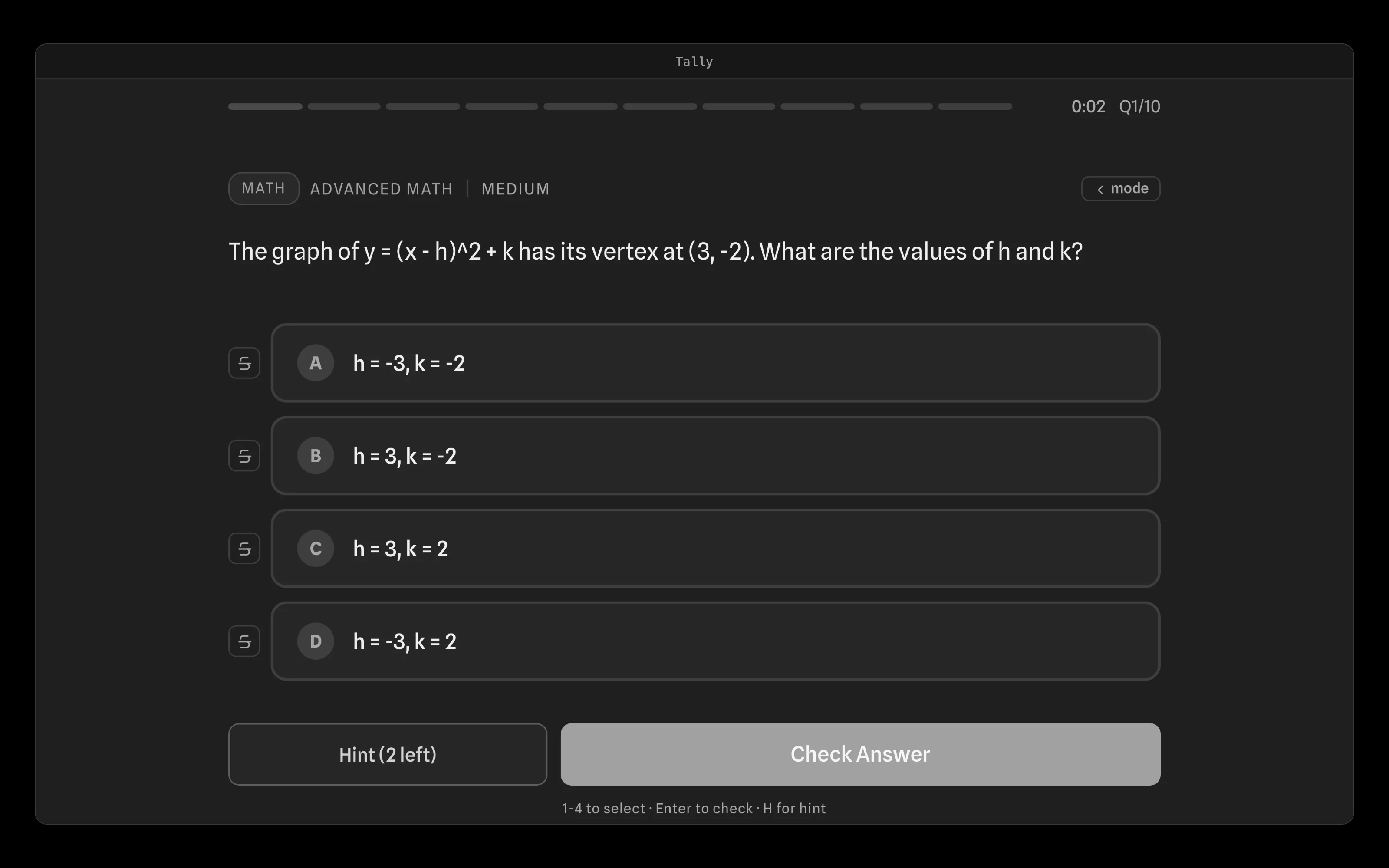
Practice in short sprints
Each sprint question shows a running timer and allows up to two hints, and every answer choice has a button that crosses it out. The keys 1 to 4 pick a choice, Enter checks the answer and H shows a hint.
Review gaps and the predicted score
A missed question goes into a review queue on the SM-2 schedule and comes back a day later. The first correct review keeps the gap at 1 day, the second sets it to 6, and each one after multiplies the last gap by 2.5. A wrong review sends the card back to 1 day.
The predicted score appears after 10 answered questions. For Math and for English it weights the last 60 answers by difficulty, counting easy as 1, medium as 1.5 and hard as 2, maps the weighted accuracy onto 200 to 800, and shows the total with a range of 40 points either side.
How it is built
The question bank is a JSON file of 1,062 questions, 567 in Math and 495 in English, that seeds the database the first time the server boots. Most of them were generated by AI.
The front end is React 19 with Vite, and the API is Express 5, which also runs as a Vercel serverless function. Progress lives in its own schema in Supabase Postgres. Without a Gemini key, the difficulty targeting and the coach’s insights fall back to fixed rules; answer explanations and score-report import need the key.
Features
- Practice
- Sprints, a review queue, full timed practice tests and a study plan with a target score and test date
- Mobile
- A Capacitor Android project is scaffolded in
android/. The plan in the repository lists the iOS build as waiting on Xcode.
Timeline
I started the repository as ADHDSat, the name it still has.
The rename to Tally was decided and recorded in
REBRAND.md.My Focus and My Drills pages joined the sidebar.