ShipKit
ShipKit checks a web project against 18 rules for problems such as an exposed service key or a missing 404 page, and can generate the fix for eight of them.
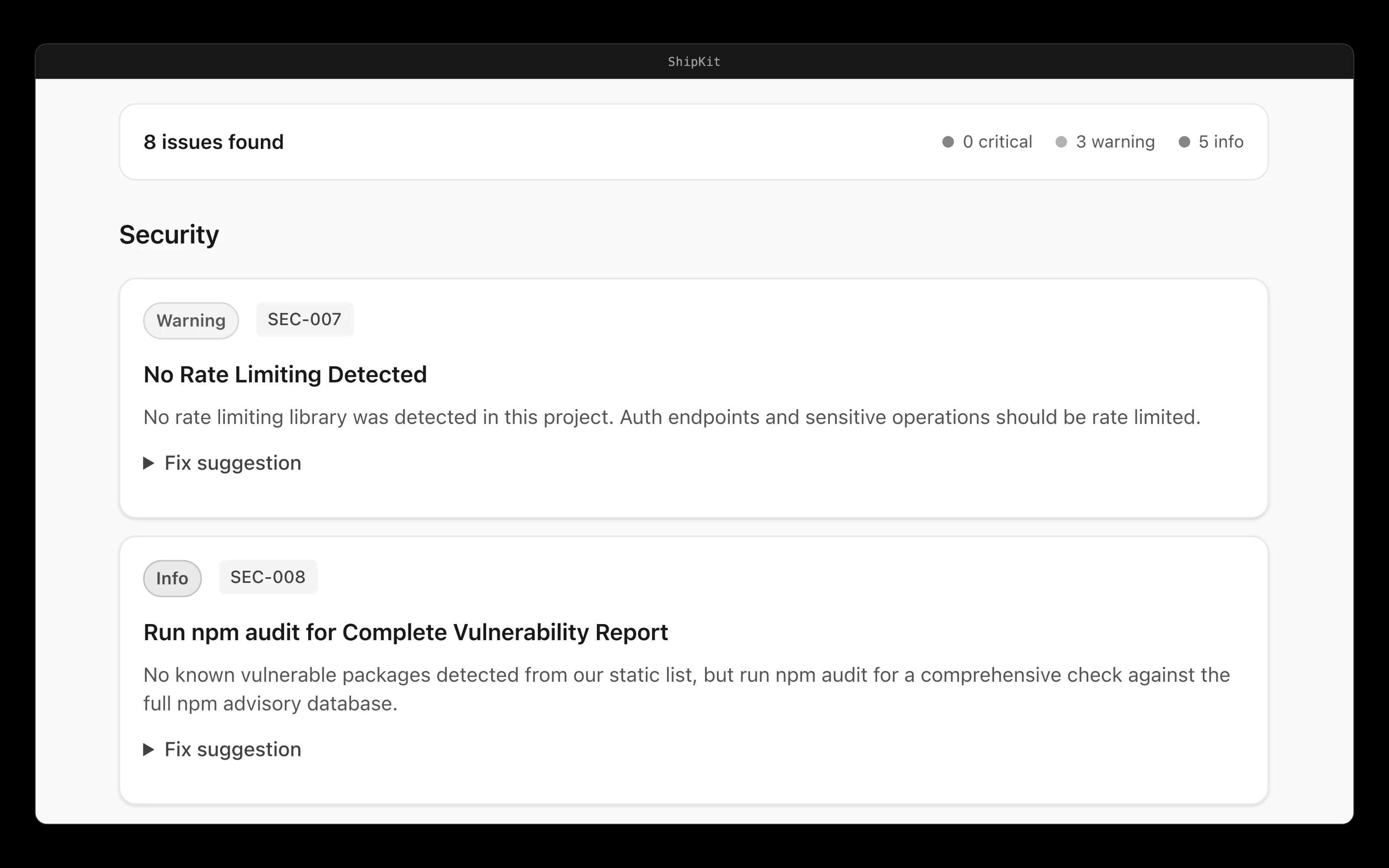
What it catches
ShipKit is a Next.js app for projects built with AI tools. Connect a GitHub repository or upload a project, and it returns each finding with how to fix it and a score out of 100.
The 18 rules
Each rule is a plain TypeScript function that reads a snapshot of the project’s files and configuration and returns findings. No model is called during a scan. The rules run in a fixed order, the 8 security rules first, then 5 for deployment and 5 for quality. If one throws, the scan carries on without it.
Progress streams to the page over server-sent events, one event as a rule starts and another as it finishes. The score starts at 100, and each critical finding takes off 25 points, each warning 10 and each info finding 3, down to a floor of zero.
The rules that can write their own fix mostly create the missing file, such as a vercel.json, an error.tsx or a not-found.tsx, and a few edit files that already exist. Every suggestion today comes from the rule’s own text. A module in src/lib/ai would ask Claude Haiku for a short fix suggestion and fall back to the rule’s text when the call fails, but nothing calls it yet.
SEC-001 critical Exposed Supabase Service Role KeySEC-002 critical Hardcoded Credentials or API KeysSEC-003 critical Missing Supabase Row Level Security (RLS)SEC-004 critical Auth Routes Missing Server-Side VerificationSEC-005 warning Missing or Overly Permissive CORS ConfigurationSEC-006 warning Unvalidated User Inputs in API RoutesSEC-007 warning Missing Rate Limiting on Auth EndpointsSEC-008 critical Vulnerable Dependencies DetectedDEP-001 critical Missing Build Script in package.jsonDEP-002 warning Missing Deployment Configuration FileDEP-003 critical Missing SPA Redirect RulesDEP-004 critical Required Environment Variables Not DocumentedDEP-005 critical Localhost Database Connection StringQUA-001 warning Missing Error Boundary ComponentsQUA-002 info Missing Loading StatesQUA-003 info Missing Custom 404 PageQUA-004 info Missing SEO Meta TagsQUA-005 info console.log Statements in Production CodeAround the scanner
Supabase handles auth and data, with one migration devoted to row-level security policies. A deploy wizard uses the Vercel API and can roll a deploy back, an uptime monitor runs from a cron route, and Stripe handles billing. A public showcase page and an Open Graph image route show a project’s score.